It means that usually only men use that form. Imagine the ‘big boss’ stereotype – very gruff, easy to anger, laughs loud, expects obedience from everyone – for the image of “quite masculine”. I’m exaggerating, of course, but in that direction.
It only reflects on the speaker, so it wouldn’t necessarily be bad to say to a woman, just kinda rough to hear. It could be said by a woman but it’s probably very unusual. (I’m not saying anything is absolute in this day and age.)
1 Like
I can’t understand when I should use んだけど instead of just けど, they both look the same to me
1 Like
This part I don’t get… it has a “fun fact” about how ん (or の) may sometimes be omitted, but the example given afterwards doesn’t omit it?
Fun Fact
ん (or の) may sometimes be omitted completely, but this is not so common in modern Japanese.
2 Likes
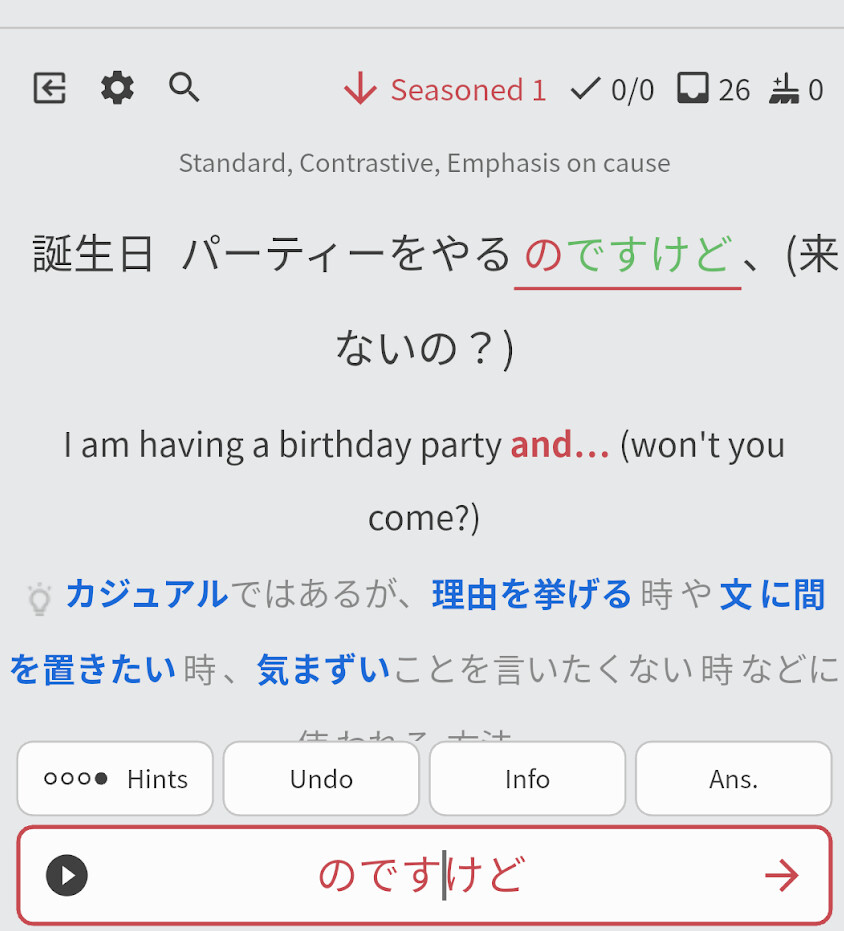
Why is it that のですけど is not included in this grammar point? To my understanding, it is synonymous.
It is currently included in the structure section as an acceptable option.
But, I just got marked wrong for suggesting it as an answer (see below). But I’m guessing it’s just too hard to support the full combinatorial explosion of answers that is possible from the pattern in the lesson?
There are 3 component to the structure:
- ん or の (2 options)
- だ or です (2 options)
- けれども or けれど or けども or けど or が (5 options)
A total of 20 combinations exist. I think in the question below there were about 8 or 9 accepted options. I don’t think there’s any particular reason mine was rejected, but I honestly don’t know for sure, and clarity would be nice (for understanding, not for scoring a review point… I already marked it correct).