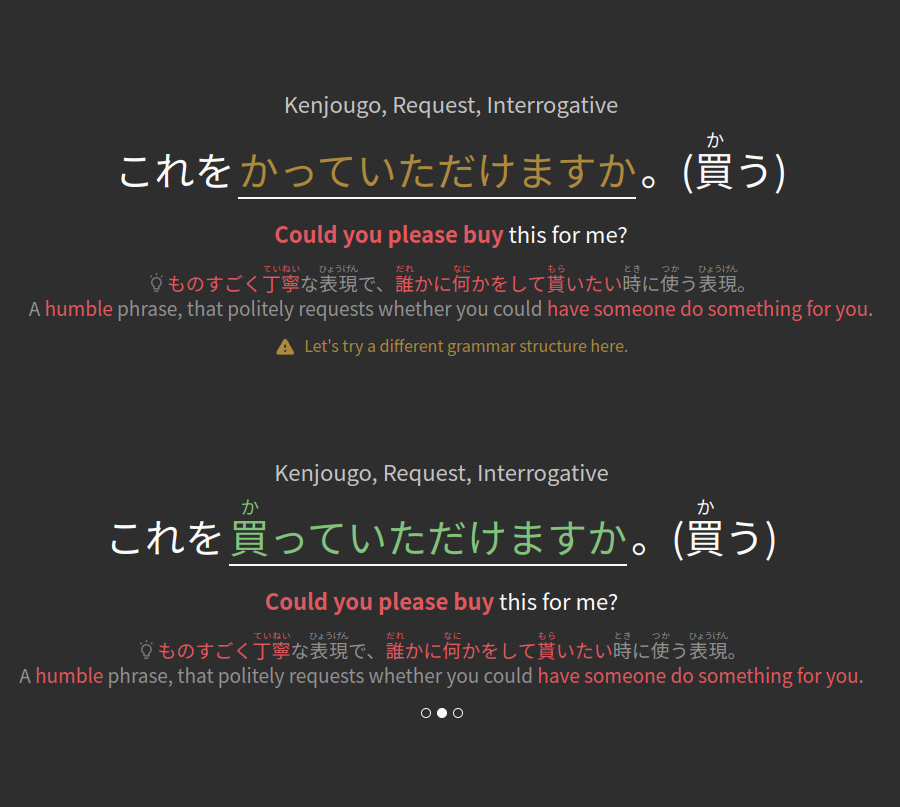
could you please
[humble request]
Structure
- Verb[ て ] + いただけません・か
- Verb[ て ] + もらえません・か

could you please
[humble request]
Structure
- Verb[ て ] + いただけません・か
- Verb[ て ] + もらえません・か
What situations would もらえませんか be used? Is it more/less formal?
Thanks! I bet there’s a lot of good stuff buried in this forum; I need to do a deep dive one day, haha.
これを かってくれていただけませんか 。
Just wondering why this is incorrect for “Could you please buy this for me?”. Is this phrase a request for someone to do something for the asker in its own right?
I’m not a native English speaker so sorry if this is wrong, but I think the translation
Could you please return home by nine o’clock?
of
夜9時までに帰っていただけませんか。
is a bit misleading. To me the translation appears to request the recipient to arrive home at 9 and is hence said by someone probably living in said home, e.g. the their SO (although it would admittedly be somewhat weird for them to use 謙譲語). The Japanese on the other hand can only be said by someone who want’s you to leave (and probably lives elsewhere), otherwise they would have to use 帰ってくる, as explained to me by a native speaker. Therefore “go home” rather than “return home” seems like the better translation here. Assuming my understanding of the English language is not wrong here, would you mind updating the translation?
@CrisH Hey! I apologize for the extremely late reply! てくれる and ていただける both essentially mean the same thing and they both indicate that the speaker is having something done for their sake. The main difference boils down to formality. てくれる is also closer to “do for me,” while ていただける is used when you want to formally request that you “have something done (for me).” Cheers!
@pampel Hey! While “return home” is less common, it can mean the same thing as “go home.” “Return home” is used more often in formal situations (hence its use in this sentence), while “go home” is used in casual situations. The difference between the two is that “return home” can also mean “come home,” while “go home” obviously cannot. Since this was a point of confusion, I have added “go home” to the hints for this sentence so that you know not to attempt 帰ってくる. Cheers!
Thanks for posting that and thanks Pushindawood for the answer. I also got it wrong for the same reason (2 years later) and came looking for this grammar point. 
With lots of humble phrases you need to use お or ご before the verb. Why not here? Are there any rules to this?
First off, even though いただく itself is a humble expression, the thing before いただく is something the other party does; a humble form would not be used for it.
But it is possible to separately use a respectful お/ご with いただく too, in the same way as with ください etc. For example, ご連絡いただく or お電話いただく. It’s just not necessary in most cases because いただく already gets the point across.
I guess this grammar point has the て form in the name too, so answers without it don’t fit for that reason too. For example it’s not possible to just add an お to something like 帰っていただく, it would have to be changed to お帰りいただく. They can’t just be added to a verb in the て form.
Another thing to be aware of is that e.g. adding お or ご to something like 電話していただく is wrong as well because お電話する is humble and humble expressions should only be used for one’s own actions. However without the お, it’s completely fine.
I’ve acclimatized to very similar concepts being wrong/different on Bunpro with how the grammar points are set up (or how conjugation, spelling, and form seem to be used interchangeably, at times), so that’s fine, but an error message that virtually says “nah” without any details to what it’s looking for instead, feels like getting cut down at the knees.
I try to take stuff like this on the chin and adopt a “git gud” mentality, but this feels less like a failure to comprehend the grammar/language and just more like an anachronism of Bunpro.
I’ve just recently reached these first few Sonkeigo and Kenjougo grammar points so maybe this will all make more sense later on, but at the moment I’m pretty confused with how this item is about requesting a favor of someone else, but Kenjougo is described (in another grammar point somewhere) as being all about the speaker’s own actions. Sorry if this question is bit outside the scope of this particular grammar point, but if there’s an easy way to square this circle, I’d love to hear it. 
Both いただく and もらう mean “to receive”. In this way, these are actions of the speaker, with いただく being the humble version where the speaker receives something from a higher up. This perspective makes it consistent with Kenjougo being about humbling the speaker’s actions down.
すみませんが、後ろに乗っていただけませんか。
Excuse me, would it not be (negative form) possible (potential form) that I could humbly get (speaker’s action) you to sit in the back (listener’s action is the contents of what the speaker receives)?
It’s quite awkward to spell out “humbly receive a favor” in English, so more natural translations make it sound like it’s just a listener’s action.
Te-form is where the transition from the listener’s action 乗る to the speaker’s action いただく happens.
I see, it makes complete sense now. Thank you!