ように・ような - Grammar Discussion

Hmm, looking closer at https://bunpro.jp/grammar_points/628 it seems somewhat different? I interpret that to be more along the lines of “in order to/not to” or “so as to”; for example: “in order not to get a cold, I wear warm clothing”, whereas this usage feels quite different.

I quite like the “as you will” interpretation, so:
As you will understand, if looking at these photos…
As you will understand, if you travel to this place…

I’m wondering how it works with other verbs, can one do something like:
食べれば経験するようにそのレストランのカレーが辛い

This feels a little bit wrong, but I’m just wondering what sort of other verbs can be used in this scenario.

Hm. That is an unfortunate misreading of my explanation.

I was focused on how ように describes わかる. It is attached to a desired outcome (listener’s understanding), and that outcome is something outside of the speaker’s control. Also here, I see the comma is taking the place of an omitted phrase — the speaker’s action. I added one comma for clarity. (Classical Japanese carried no commas at all.)

この写真を見れば、わかるように 写真を見せてあげる、ロンドンは色々な名所がある
If [one] looks at this picture, I show you this picture [with a hope that] such that [you] understand, as for [with the topic of] London there are various famous places.

Of the Bunpro grammar points, the one I selected seems to be the closest to explain it. If there is another page to point to, I’d happily accept another explanation.
For example, this point could apply as well:
https://www.bunpro.jp/grammar_points/379

I don’t think there is a desired outcome here.

This interpretation sounds strange to me. The condition has to become true for the consequence to occur. But when the person is already looking at the picture, it’s not necessary (or possible) to show it to them anymore.

And how would one make this work with the second sentence?

The speaker’s desired outcome is “you understand”. Same in both sentences.
わかるように

AようにB
A expresses an outcome that is desired

The conditional of ~見れば links with ロンドンは~. The middle is filler where the speaker is trying to politely persuade the listener to agree with the rest of the sentence. I ordered the English parts such that it makes sense in English.

Could you provide your interpretation of the sentence? Or what grammar point makes わかるように into “as you will see”?

This thread’s original grammar point doesn’t work because it’s focused on similarity. There is nothing in the sentences that is similar to “you understand”. You would need something like:
彼はわかるように目をつぶった。
He closed his eyes like he understood. (like showing he understands)

The interesting thing is the example I gave from the text book is taken from the section where the similarity ように grammar is taught (and is also linked to from that chapter here on Bunpro)

My teacher tried to explain the first part of the sentence as being a type of example, which sadly didn’t make things any clearer.

I have a feeling this is another area of grammar that perhaps doesn’t translate well and just needs storing in the “things you just learn” part of the brain without digging too deep into it.

1 Like

The 見れば does. みればわかる is a common expression.

I provided my interpretation before. “As you can tell from the picture(s),…”.

The reality that London has a lot of famous places is similar to the understanding you get from looking at photos of it.

Personally, I would write わかったように here.

My impression is that when Japanese speakers use “example” like this, they often mean “illustration”.

1 Like

In the sentence" かれくるま工場こうじょうのようなにおいがする",

Why is it ような despite 臭い being an い-adjective?

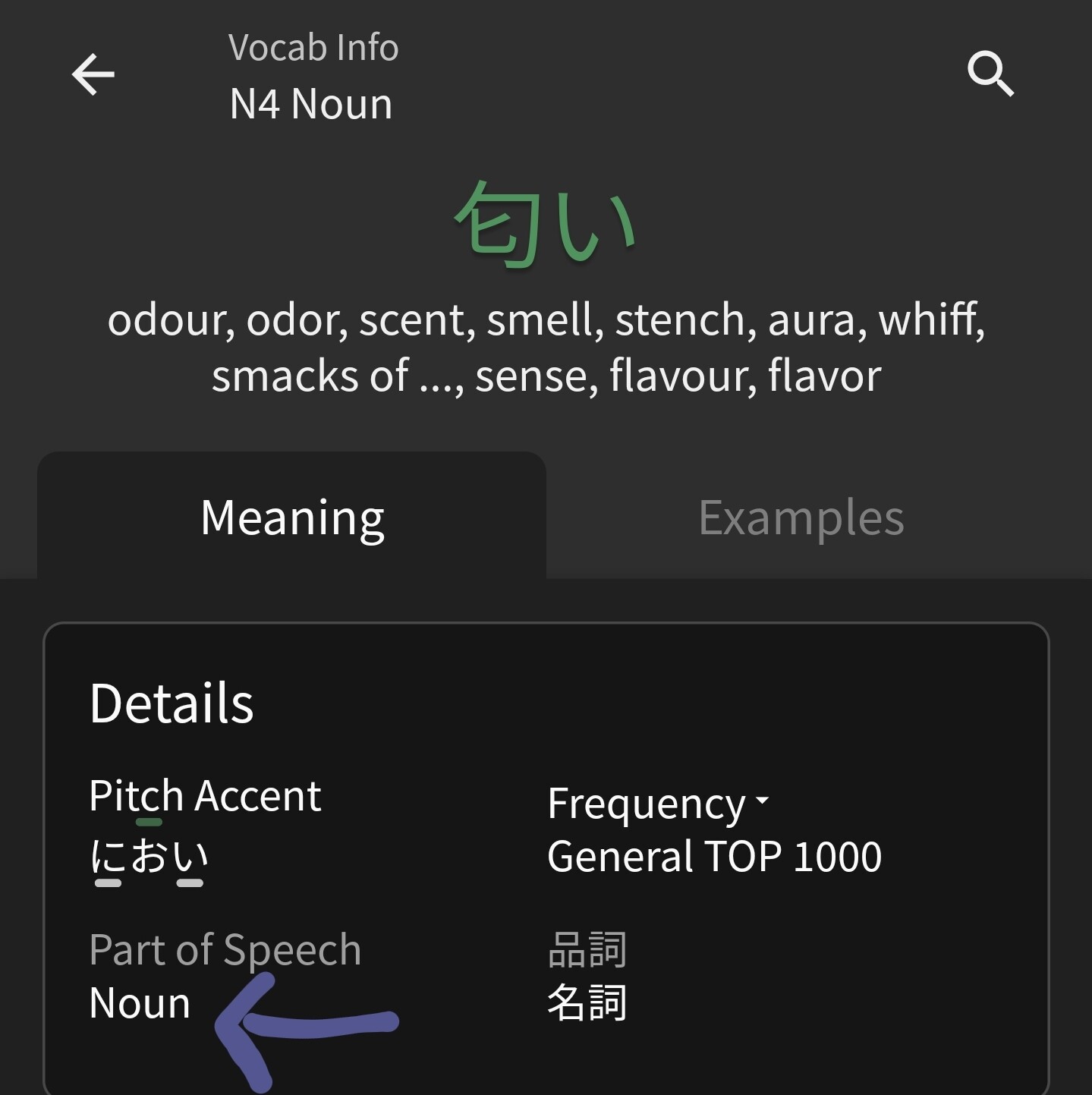
Smell 臭い(におい) like “what’s that smell/scent? Apples?”
Not that it’s “smelly” like 臭い(くさい)the smelly adjective.

臭い/匂い does end withい but this is a noun. The different kanji can be used, with 臭 having a negative nuance. Although I like factory smelling cars (⁠ب⁠_⁠ب⁠)

“Giving off a factory like smell” “smells like the factory”

1 Like

Ah it is good to see you again, I will always remember your Shiny Umbreon PFP lol

Thank you for the explanation, that makes perfect sense now

1 Like

This lesson’s structure rules and examples are a bit misleading, it’s easy for a beginner to mis-chunk the clauses and end up using the wrong particle.

  • Verb + ように + Verb/Adjective
  • Verb + ような + Noun

彼の車は工場のような臭いがする。 - Adverbial Clause (which should use )
彼の車は工場のような臭いがする - Noun (which should use )

バケツをひっくり返したように雨が降っている。** - Adverbial Clause (which should use )
バケツをひっくり返したように雨が降っている。 - Noun (which should use )

I think the lesson structure needs to differentiate the following:
Adverbial Usage: X is similar to (よう) Action A.
Adjectival Usage: X is similar to (よう ) Thing A.

2 Likes

Ohhhhh!!!
Thank you so much, I was so confused! I couldn’t understand why sometimes before a noun に was used, and the opposite!
Perhaps your explication should be added to the grammar point! (Or maybe it’s not japanese related, but grammar-in-general deficiency that I have, anyway thank you again!)

I have to say this whole grammar point is utterly confusing and should be redesigned imo.

The usage pattern above is not found in a single example on the page, where ように is always paired with の just as in previous grammar points regarding ようだ.

Whereas the usage pattern suggest it should come modifying a verb.

Also as @NathanBell_Au explained very eloquently, it is also confusing at first when exactly な or に is used here.

1 Like

I’m also not a 100% on this, if the grammar point is meant to be verb + ように/な + verb/noun, why are so many of the example sentences noun + の + ように/な + verb/noun such as 彼は亀のように走る? I’d appreciate it if the grammar page made it clear why this grammar point is split into two pages as such.

Why are these sentences using ように instead of ような?

バケツをひっくり返したように雨が降っている

あなたが言ったように、事故が起こった。

ような is for nouns, ように for verbs. Yes it comes before a noun, but it’s taking about the action.

“The accident happened like you said”
“Is raining like a bucket was tipped”

3 Likes

I’m a little confused why it is ように in 君()()うように綺麗()ですね。

The rules listed on the page made me think that 綺麗 would make it ような.

Sometimes, this structure is used purely to express the speaker’s uncertainty about whether (B) really is being done/existing in the way of (A). In these cases, ように (or ような) will be translated as ‘as if’, or ‘as though’.

can ように in this case be used with past-tense verbs as well? e.g.

彼は今、人を殺すような目をしている。
(Right now, his eyes look as if he is about to kill someone.)

彼は今、人を殺したような目をしている。
(Right now, his eyes look as if he has killed someone.) <----- Would this be correct?

2 Likes

It certainly can be! In the situation you described, it also slightly changes the nuance.

殺したような目 makes me think of someone with a crazed/panicked look as if they had just committed the act.

殺すような目 makes me think of someone that is more full of hate that is on the verge of something.

In general, when something can be used after the ‘standard’ form of a word, this just means any form that isn’t です/ます. That means 〜る、〜た、〜ている、〜ていた、〜ない、〜なかった、〜ていなかった etc

2 Likes

that makes sense! Thank you for the detailed explanation :slight_smile:

1 Like

I think the structure on this lesson needs to include:

Verb + よう + に + Phrase

Currently it only lists verb/adjective/noun as being modifiable, but it’s clear in some cases that an entire phrase is being modified. E.g. consider this example:

うように綺麗ですね。
It is beautiful, just like you say.

If we claim that only the verb (the copula です) is being modified, then that implies the speaker is agreeing with every existential claim you made about this place (i.e. “it exists just in the way that you say”). I.e. maybe you said that it is other things (in addition to beautiful), but the translation makes it clear that the speaker is agreeing specifically with a single assertion (i.e. “it exists as beautiful in the way that you say”).

Alternately consider this dialog, written in English for simplicity:

Alice: This thing is big, beautiful, and cheap.
Bob: It is indeed big just like you say.

Bob does not agree that it is beautiful or cheap. The “just like” modifier isn’t merely modifying the verb (the copula). If it was, he’d be agreeing with all of your assertions about the thing’s existence (which completely changes the meaning of his response).

I also believe both of these examples fit the “modifier + phrase” pattern:

あなたが言ったように、事故が起こった。
An accident happened just like you said.

Presumably they’re not saying “the accident happened in a specific manner that you described” but “an accident happened, period, as you claimed it did happen”.

十代に戻ったように楽しかった。
It was fun, just like being in my teens again.

Obviously the verb “return” by itself is not what’s being labeled as fun, but rather the entire concept/phrase “returning to teenage years”.