
SRS is great for reviewing a grammar point exactly when you’re about to forget it. It’s an efficient way to study daily without having to manually hunt for resources. You open Bunpro, fill in the blanks, succeed or fail, and close the app. Simple, right?
However, after two years of daily use, I realized what was missing from this method: nuance.
I’ll be honest: because I do SRS every single day, I often try to get through my reviews as quickly as possible. When I see a blank space, I’m highly biased by the “ghosts” I’ve recently generated or the new points I just learned. I find myself filling in the blanks without truly reading or understanding the full sentence.
I put my brain on autopilot. I still maintain a solid 90% score, but was I actually learning?
It’s like going to the gym and lifting the same weights you did on your first day. You can do it smoothly without breaking a sweat. Adding new grammar is just like adding new exercises to the routine, but if you keep everything “lightweight,” you’ll barely see any progress.
I recently started using JLPT materials (like Shinkansen Master), and they are a fantastic supplement to Bunpro. They help me understand the nuances between similar points. It’s not SRS, and it feels very “textbooky,” but when faced with multiple-choice questions, I have to ask myself: “Why is this the correct answer and not the other three?” I’m not just recalling one point; I’m weighing four options against each other to see which one fits best and why.
It sounds simple, but it took me two years to realize that SRS alone isn’t enough; not for grammar, and likely not for vocabulary either.
Also, a small observation: it feels like Bunpro sometimes introduces grammar points based on shared Kanji roots (for example, finding 抜く followed by 抜きで). While they share a root, their meanings are completely different. It feels less helpful to “nuance” these two than it would be to compare a point with a grammatically similar one.
SRS is training your active memory while Textbooks are training your critical thinking.
One thing I’ve noticed is that Bunpro’s explanations often lean heavily into the mechanical “roots” of a grammar poin;focusing on the Kanji, its standalone meaning, or how it attaches to the masu-stem. While that’s helpful for building the sentence, it sometimes lacks the “emotional context.”
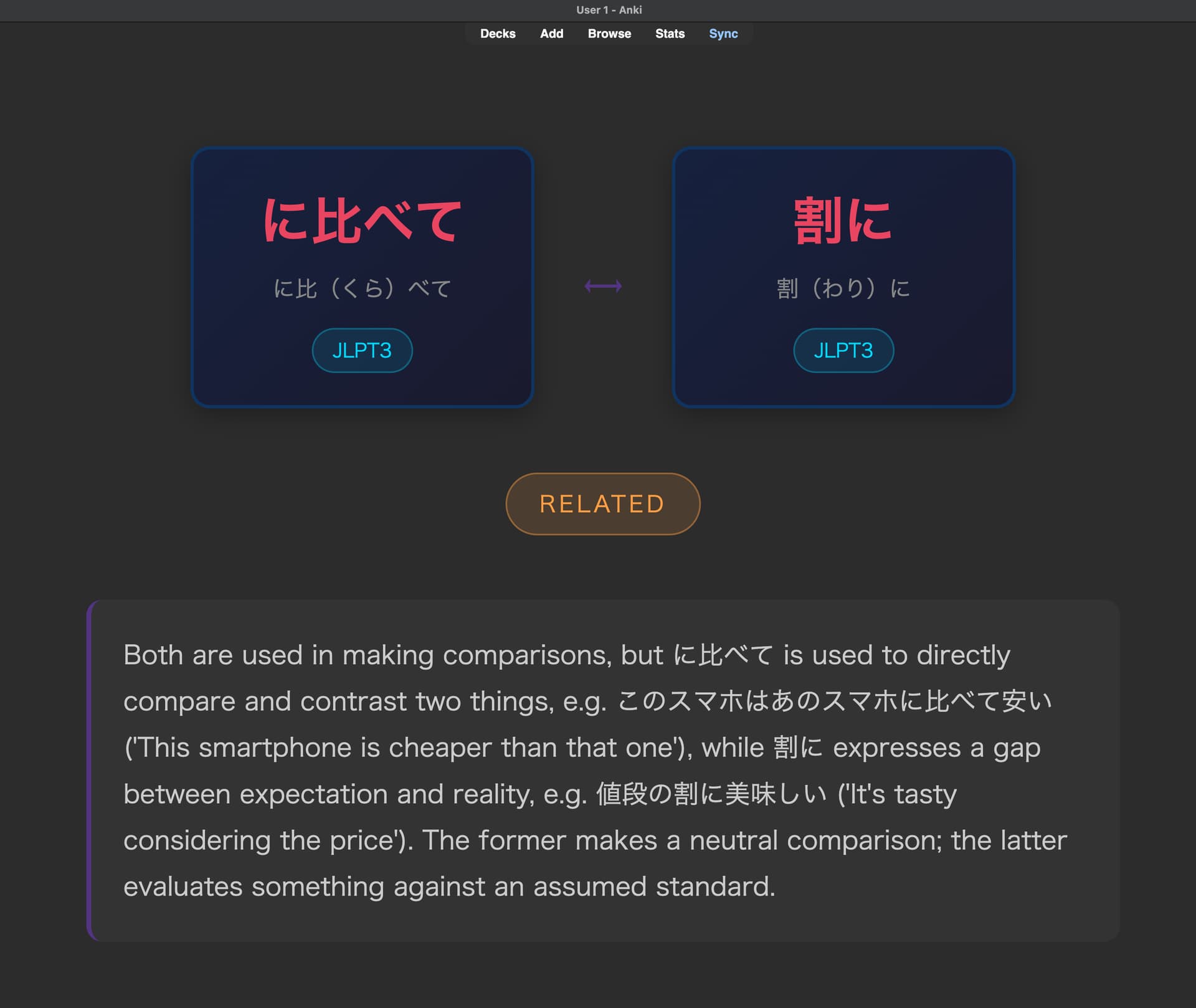
I’ve found that I need to know more than just the formula; I need to know the vibe or the specific situation where one grammar point is preferred over another. The “Related Grammar” section and “Cram” features are lifesavers for this, but they require a lot of manual digging to truly understand the emotional weight or nuance that a textbook like Shinkansen Master explains upfront.
Tell me if you are using external resources to cement the nuances, I’m very interested to learn about different resources I could use to nuance vocab and grammar.
Good luck !

 sorry, forgot to unjack from AI Hive mind before posting