Is N1 Grammar easier than N2 for you?

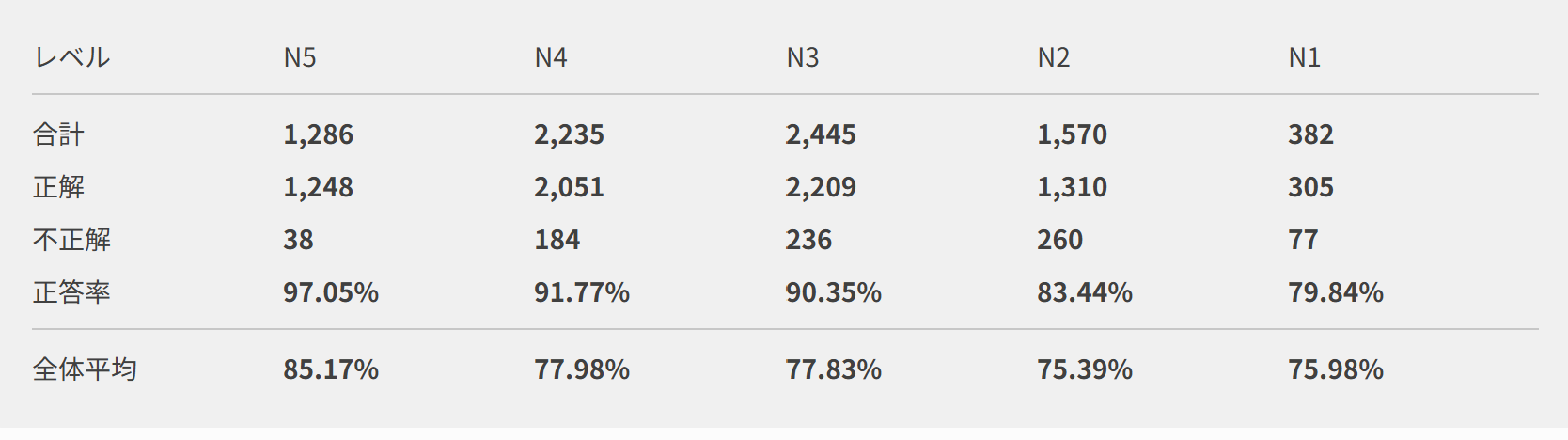
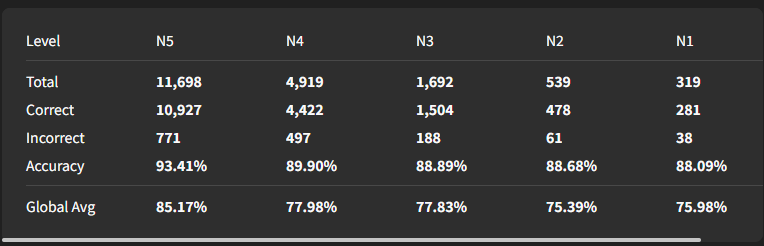
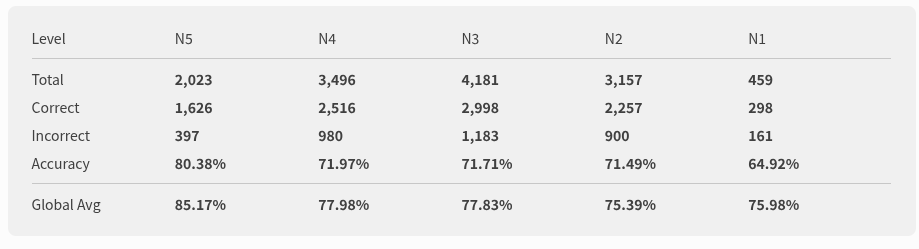
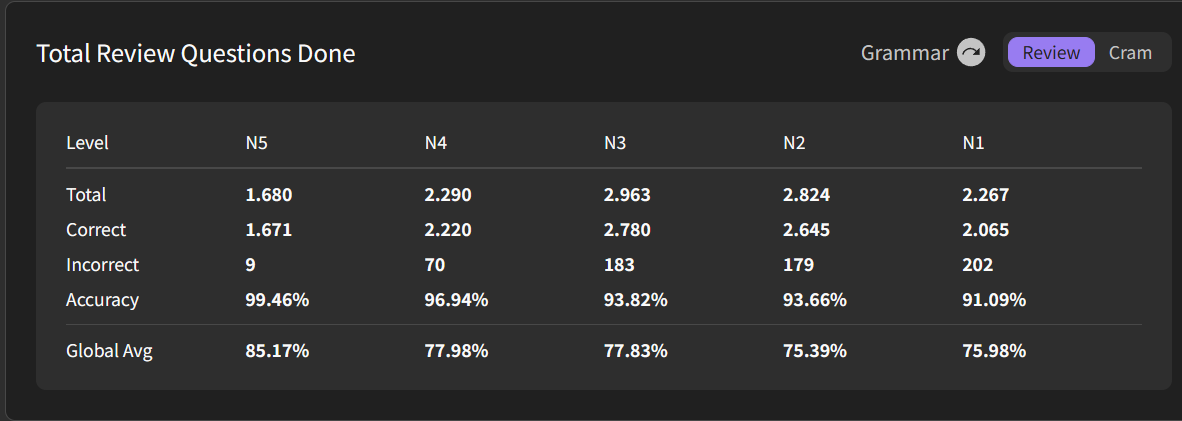
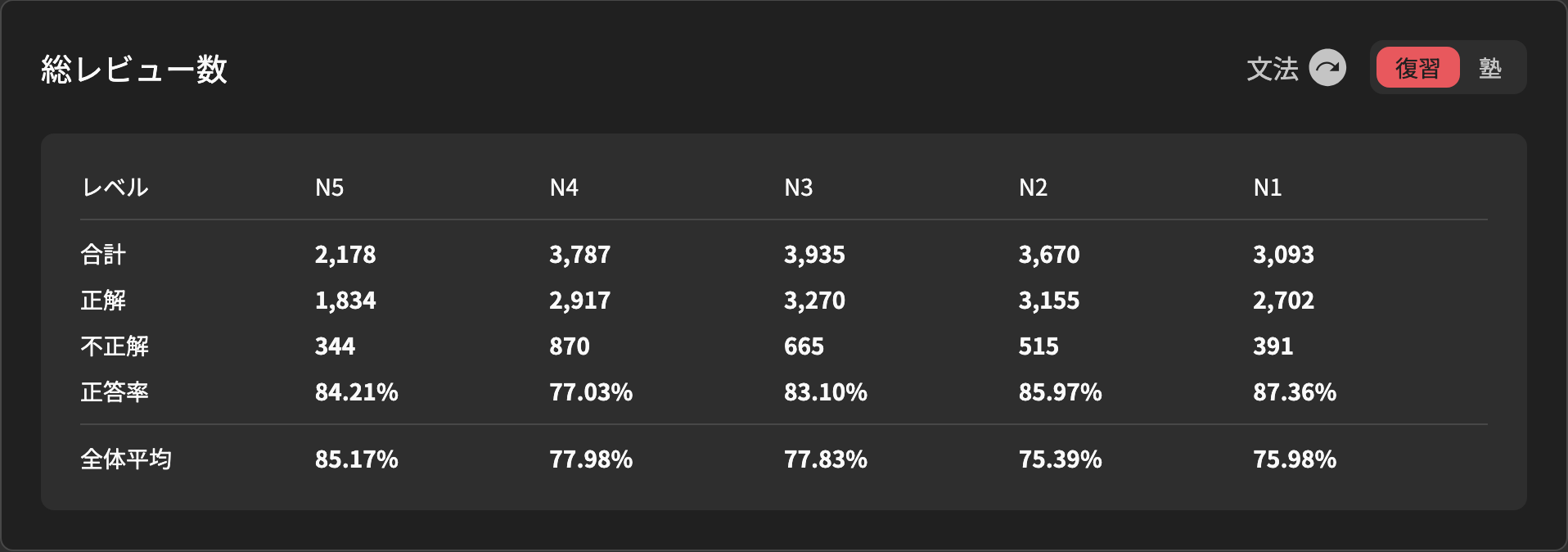
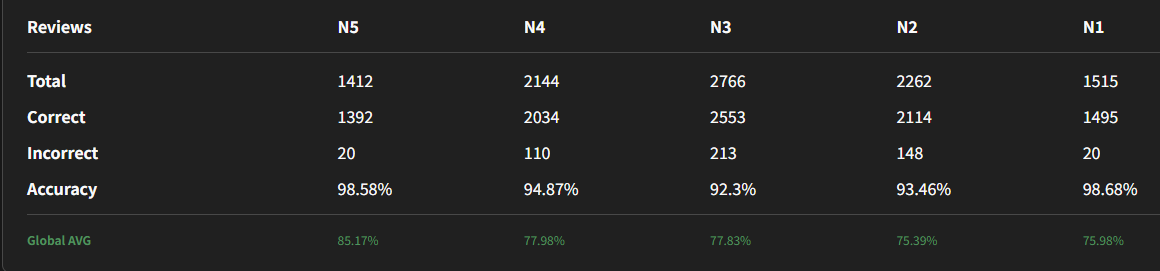
Ive just noticed that the Global Avg. for N1 (75.98%) is higher than for N2 (75.39%). What is the experience of people here? Is N1 really easier than N2 for you? As you can see by my accuracies, I did drop a good 2.5% from N2 to N1 and IMO N1 Grammar points are harder than N2. Mainly because its less grammar which I could intuit and more Vocab which I need to learn, and Im too stupid to memorize stuff.

Also one thing beside this topic: I heard that there is some sort of “Master +” area but Ive had alot of grammar on Master for a while and it still only shows the areas for Beginner → Adept → Seasoned → Expert → Master, but no Master+ as you can see:
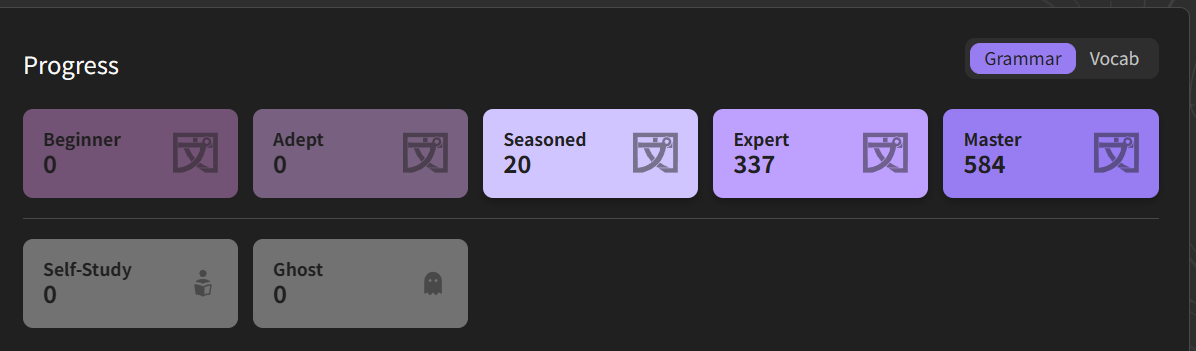
Maybe Im missing something?
1 Like

I’m still a lowly N3 pleb so can’t offer insight on the difficulty there, but master+ is a toggleable setting that is off by default.

If you haven’t turned it on, your master items won’t come back into your review queue

(post deleted by author)

Ahh thats why, thanks!

IMO the statistics on global and even personal accuracy are very crude and are more or less junk stats. There’s so so many different ways to use Bunpro that a singular number isn’t representative. Note that the difference between N3 and N4 globally is 0.15%.

According to the app my N4 accuracy is worse than my N2 accuracy, but that’s just because I marked a few N4 grammar I wasn’t familiar with as Beginner.

My explanation for why global N2 accuracy is slightly lower than N1 is more people attempt N2, but struggle, whereas N1 learners already know how to “learn” Japanese. Alternatively N1 may be perceived as harder, so learners take more time to master the individual grammar points.

IMO after N2 (maybe even N3), kanji, vocab and grammar doesn’t get “harder.” Just less frequent and expressing more nuance. In fact truly mastering earlier grammar points like は VS が, or the passive voice I’d consider “harder” than most N1 grammar points.

I indeed have higher N1 accuracy than N2. It’s also higher than my N5 accuracy.
I went in with no knowledge.
N4 was the worst for me for some reason.

1 Like

To be fair, I think the hell of synonym of N3 is the worst, because at that level you’re not that well-versed in Japanese grammar. N2 is another challenge, less so than that of N3. However, once you’re touching N1 level grammar, it now feels more like another vocab session to me, as by then I know how to break down grammar points, and does not get confused as often.

In short, N3 , N3 is the WORST!

1 Like

Since all grammar points in some way, shape or form refer to (and are a combination of) the basics, I agree.

The reason why difficulty still feels like its increasing For N5-N3 is because later grammar uses these basics in more and more nuanced and complex ways. So yeah, I feel like every new grammar point is always a question of “Have I truly understood the basics” more than anything.

Though do I agree that everything after N2 doesnt get harder? Well not necessarily. Take grammar points like: “におけるがごときもので” which no doubt falls in N1 and would be too hard for most N2 learners to understand if placed alongside the other N2 grammar points.

1 Like

Is that last piece (におけるがごときもので) an actual grammar point (not in Bunpro?) - right now my main source is Bunpro for grammar.

(A)におけるがごときもので(B) means roughly: “Alike that which could be found within (A), (B)” so its just a fancy simile.

I found it in the older novel “吾輩は猫である” and Its a very niche grammar point so it makes sense why Bunpro doesnt have it.

Btw, the usage of “おけるが” instead of “おけるのが” (Since this が is not contrastive) as well as the attributive form of ごとく, “ごとき” are both quirks only found in older Japanese.

Although its old, technically its also just combination of what bunpro already teaches: に (particle)+おける (Verb → to locate)+が (particle)+ごとき (from the simile 如く(ごとく))+もの (物)+で (particle).

1 Like

That’s interesting, thanks for the writeup.

I get where you’re coming from, and it is semantics after all, but that I believe falls outside of N1 grammar. Archaic and literary grammar is very niche to learn, even if Nastume Souseki wrote it. Even then I don’t think the grammar is more complex or “difficult” - it’s just extremely niche for daily usage.

At the end of the day I think it just boils down to the individual definition of what someone defines “complexity” or “difficulty” as in the first place.

For me, if the process of arriving to a grammar point through a logical chain of thought is more layered or requires a deeper understanding of the systems that it uses, then I think of it as more “complex” or “difficult.”

This grammar point definitelly wont be used in any JLPT tests though, so yeah it definitelly falls outside of the system. Since N1 only goes up to C1 afaik, technically you could call this grammar point “N0,” which would hypothetically include C2.

1 Like

I wouldn’t be surprised if historic literary language is typically outside the scope of CEFR, not that I’m familiar with those testing standards. There’s so much depth to studying languages.

I was going to say I think N4 was harder in some ways than N2.

I haven’t studied N1 grammar for a while, but my memory of it is that a lot of it was kind of obscure and not things I came across much, so I found that difficult, but I don’t think I found it necessarily much harder than N2. I haven’t done it again to see if I still feel that way.

The hardest thing about the higher levels, IMO, is having several things that mean essentially the same thing with minor differences between them.