
Please help me parse this sentence?

困りますよ、いくら他にお客様がいなかったとはいえ、ああいうことを店の中で言われるのは。

DeepL translation:

Summary

This is rather troublesome, you know. Even if there were no other customers present, to be spoken to like that in the shop is quite something.

I see mow that とはいえ is an n1 grammar point meaning “be that as if may” but I dont understand the function of “いくら” here.

Im also guessing the のは at the end of the sentence is looping back to 困りますよ; in other words, he’s saying being talked to like that is what has him troubled, but is there anything else I’m missing?

I read this sentence like 3 times before asking DeepL and now I get it bc its translated but for some reason it was so impossible to parse :sob:

1 Like

Just think about いくら when explaining an amount.
いくら〜でも
いくら〜とはいえ
reads to me as pretty much the same though slightly different nuance. No matter how much it could be said that there were no customers… Regardless of the fact that there were no customers… etc

I hear the いくら pattern all the time in anime so now that you’re aware of it you will probably pick it up in no time.

This might help with some references

4 Likes

The いくら used here is showing extent or degree (at least that’s how I read it). Like “no matter how true / to whatever extent it was true that there were no other customers”

1 Like

Thank you both! :slight_smile: I studied ikura ~ demo on bunpro, but I wasn’t sure if it was the same grammar point
Just wanted to add that even though Bunpro doesn’t include it in their grammar point for とはいえ, if you search for いくら and とはいえ together, you’ll get other sources that list them together, such as this one:

It’s basically just adding additional emphasis to the とはいえ point.

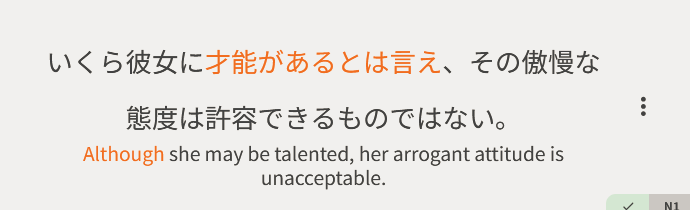
I took a look through Bunpro, and I noticed they have this example sentence for the vocab entry of とはいえ:
image
It’s translated as “Although she may be talented. . .” but I think it would also be natural to interpret it as "No matter how talented. . . " as others have mentioned above. Bunpro staff can correct me if I’m wrong though :sweat_smile:

3 Likes

That website looks really helpful, thank you!

I have another question about the following sentence

夏中引きこもっているのも人としてどうかという気がしなくもなかったのだ
DeepL- I couldn’t help but feel that spending the entire summer holed up indoors was hardly the way a person should live.

I am having a hard time of conceiving how 人としてどうか is equivalent to “the way a person should live”
I generally have trouble with these kind of vaguer embedded questions I think… Does anyone have any tips?

DeepL is kinda rubbish in my experience. It is good for giving you a fast translation, sort of in the right ball park, but for parsing text, I have more success with LLMs, particularly Claude (but ChatGPT will do in a pinch). If you say “explain the grammar” it really chunks things out for you, and of course you can ask further clarifying questions. (that’s not to say this community isn’t doing a good job, but if you want quick replies, it will help)

1 Like

I did ask ChatGPT but I still had trouble getting my head around it :sweat_smile:

I recogonize that construction from 行くかどうか分からない I don’t know whether to go.
so してどうかと言う Say whether to do

夏中引き こもっ ているのも 人 と してどうか と 言う 気 が なくもなかった のだ
So First, I don’t know 籠る こもる and I can guess, but I’d want to look up なくもない in bunpro.
Durring summer (籠る) person whether to say notice didn’t (that’s why)
so to the dictionary:
籠る

  1. to seclude oneself; to be confined in (often written with kana only)
  2. to be filled (e.g. with emotion, satire, etc.); to be heavy (with)
    ah, like languish?

なくもない
ないでもない (JLPT N1) | Bunpro

君にそう強く言われるとそんな気がしなくもない
When you put it so strongly, I can’t say I don’t agree.
So it’s I can’t say I don’t

Put it back in the sentence , I couldn’t say whether a person who is languishing all summer…(is alive I guess?)

DeepL is an LLM. Google translate was arguably the first LLM. They both were trained by scraping the whole internet.

I actually recomend a shitty translation over a good one for learning.
That’s why I sometimes use ichi.moe when I’m studying.
Reading my lease, google translate. It’s better than I am, and it would take me hours
Reading a manga or a novel- ichi.moe

1 Like

Ah, right! This is a slightly different construction tho
kadouka - whether or not

but this one is hito toshite dou ka - as a person, how/ in what way?

Thank you for your analysis though!

What is ichi.moe?

ichi.moe
A very bad translater

ichi.moe - Japanese transliteration and dictionary service

1 Like

Jeepy T says:

  • 夏中(なつじゅう) – “all summer” or “throughout the summer”
  • 引きこもっている – from 引きこもる, meaning “to shut oneself in, to stay at home, to isolate oneself.”
  • 引きこもっている → “is staying cooped up / is isolating oneself”
  • のも – “the fact of … also / even …”
  • Here, nominalizes the preceding verb phrase (引きこもっている → “staying inside”)
  • adds the nuance of “even that” or “also”
  • 人として – “as a person” or “in terms of being a human being”
  • どうかという気 – literally “a feeling of whether it is okay / appropriate”
  • どうか → “whether it’s okay / suitable”
  • という気 → “a feeling that … / a sense that …”
  • がしなくもなかった – tricky double negative!
  • する → “to feel / to have” (here “to feel” as in “I feel that…”)
  • しない → “do not feel”
  • なくもない → “not entirely not / somewhat” → gives a hedging nuance: “I can’t say I didn’t feel …” / “I did feel … somewhat”
  • のだ – explanatory tone: “it’s that … / the thing is …”

From me:
So I think you aren’t chunking it properly. Rather than looking at 人としてどうか, based on the above you should look at 人として and どうかという気 - “whether it is okay for a person” (or “for a person”, “whether it is okay”)

1 Like

Thanks for breaking it down! You might be right about the chunking

I guess what I am really struggling with is like where do I get the nuance of “okay” from? Like “ki ga suru” just means to have a feeling and I can’t find a source for “douka” meaning “whether it’s okay”. Like I fully believe the nuance is there I just don’t see it anywhere

edit:

After some more searching, I guess it must be from this specific vibe ?https://www.japandict.com/どうかと思う?
Where douka has a judgemental nuance… I don’t know, because omou doesn’t appear in the original sentence, but that’s all I’ve got

I’m not sure if there’s a nuance of douka in an embedded question always having this nuance?

another source: どうかと思う : 絵でわかる日本語?

Idk if this is something worth having a grammar point on in general or if I’m just especially foolish for not getting this but yeah

Thank you everyone for helping me :sob:

I think you’re right in saying the どうか is judgemental. Or, どうか can also be interpreted as strange or weird as in: どうか (JLPT N1) | Bunpro or 頭がどうかしている (JLPT N1) | Bunpro.

So I think the original sentence is more saying along the line, “it’s a little weird to stay indoors all summer”. (Thats not an exact translation, since it doesn’t include the last しなくもなかった part, but more general translation for the first half).

I could be interpreting it wrong too though :sweat_smile:

1 Like

Oh, thats a good point too!

Just to steer this in the right direction, you won’t find this in a dictionary. I have been trying to think of a way to explain this and after consulting with my wife (Japanese) we came to the following explanation:

noun+としてどうか is a self-reflective questioning. Eg 親としてどうか would be questioning your parenting abilities. It’s kind of a set phrase, so maybe my earlier chunking actually made things more confusing.

Edit: you might have more luck searching monolingual resources for things like this (and using auto-translate)

5 Likes

thank you for the insight!! That’s really helpful to know and I really appreciate it.

1 Like

on a related note, I just encountered the following sentence:

私はその男がその犯罪に関わっていたのではないかと思う
I suspect that man was involved in the crime

The teacher said ないかと meant “suspect”… has anyone else encountered this grammar(?) point?

edit to add:
It seems bunpro has a point that kind of covers this: のではないだろうか (JLPT N2) | Bunpro

But the translation the teacher gave was a bit more explicit

I think you may still be leaning a little too heavily on the English translation rather than really digging into the Japanese. The verb “suspect” doesn’t technically appear anywhere in the sentence.

This is how I’d parse it (if anyone sees any mistakes here, please correct me):
私は - I plus は particle, meaning I am the topic of the sentence
その男が - that man plus が particle, meaning that man is the subject of the sentence
その犯罪に - that crime plus に particle: the crime is related to the verb in the sentence
関わっていたの - was connected to/was involved with plus the explanatory の particle
ではないか - more formal version of じゃないか - this is an embedded question
と思う - I think

I searched for “ではないかと思う” on Massif to see if I could find other examples of those phrases being used together, and there are a few hundred if you want to check some out.

4 Likes