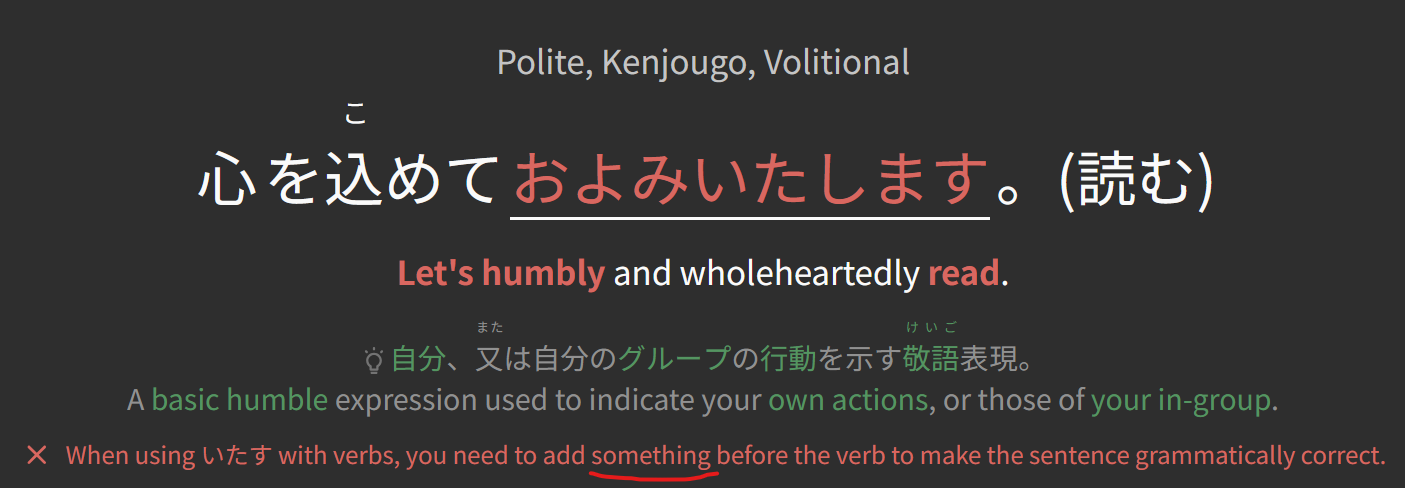
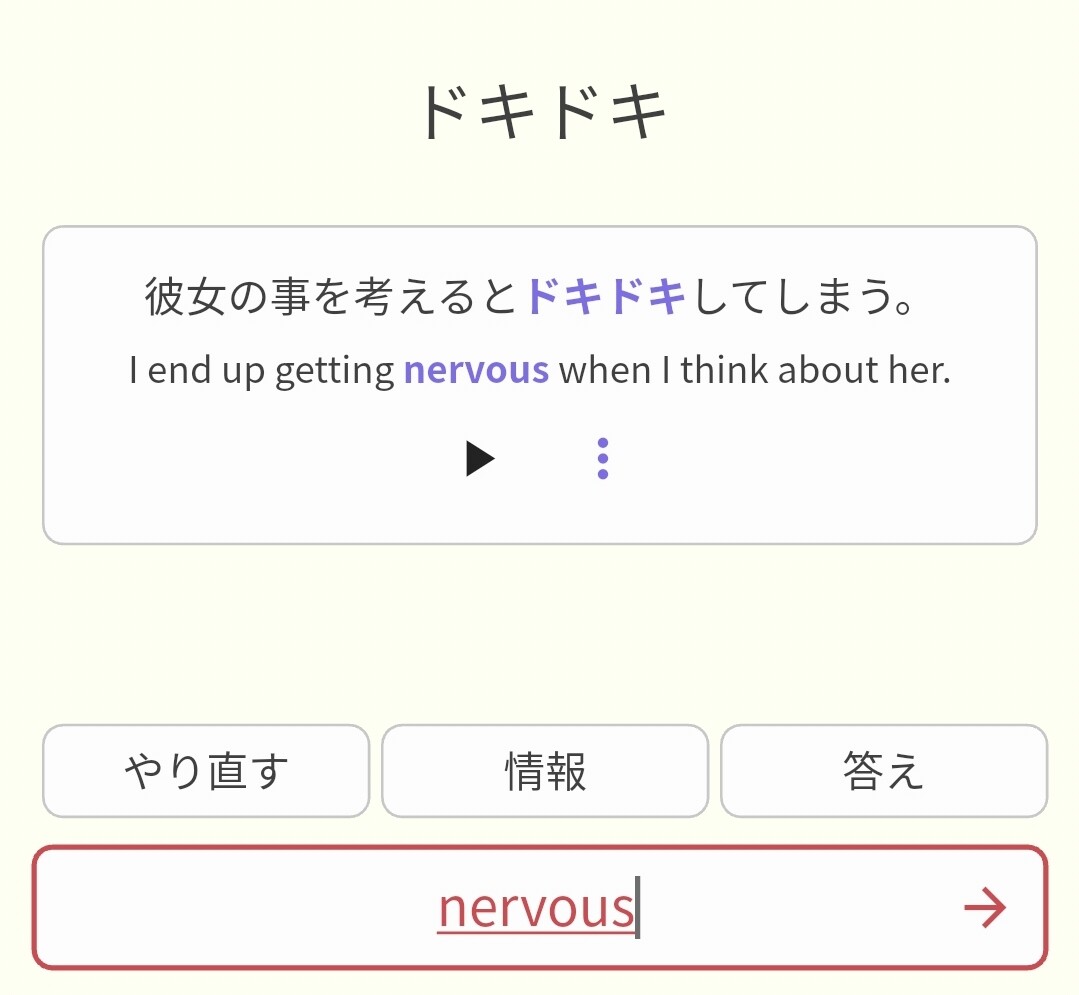
Hints that fill you with visceral rage

This is really annoying, but a pitfall of programmatic, bilingual learning. A real teacher could give you better nudges in the right direction, although I appreciate the effort for them to even include these hints instead of just marking you as wrong.

On that subject, what I like about Bunpro is the undo, so if you really can’t figure out what it is asking for, you can reveal it and if you definitely knew the grammar (just couldn’t recall for this very specific case) then you can enter the correct answer and move on. I like to share the big offenders with my wife, who is a native speaker of Japanese and I enjoy that she also isn’t sure about many of them.

10 Likes

undo is truly the real mvp

8 Likes

Since the current hints for these answers seem unclear and unhelpful, we will update these!

I will let you know when we update them!

7 Likes

I thought I was the only one getting mad at the “weaker/stronger nuances” hints… So glad to have found this thread;-; Every grammar review session feels like a never-ending “warmer hotter” game to me.

1 Like

This garbage is a mild to moderate annoyance at the best of times, but I finally just flew off the handle about one. The question EXPLICITLY stated that it wanted the answer “either in its polite or casual variant.” Upon replying with the casual variant, it started whining at me that it wanted the polite form (even though it had EXPLICITLY told me that EITHER answer was acceptable). I’d already had enough of that by this point, so I left some rather blunt, but still objective and reasonably polite, feedback. Then when I went back to the question to answer with the polite form, it decided to start moaning and bitching that it wanted the oooooTTTThhhEEErrrr polite form. At that point I swore loudly, left MORE feedback (more of an angry rant this time), and decided that BunPro had pissed me off entirely too much to even think about focusing on studying.

Look devs, I’ve done full stack, systems design, game design, that kind of stuff myself. I’ve even designed a Japanese language learning app before (built most of it out too before that project fell apart, womp womp). I know designing a large system is hard and there are a LOT of little things to consider. I also know UX design is a skill unto itself (I know because I’ve done that too). But I also know that taking the piss out of your users (even if it’s not intentional) isn’t a good idea, and that is effectively what you’re doing when you ask me a question, I answer it correctly, and you tell me I didn’t. STOP. Either don’t ask for either answer, accept either answer as correct the first time, or acknowledge that the first answer was correct BEFORE you decide to then ask me for another.

I definitely get annoyed at these too, but when I consider the alternative (just getting it wrong off the bat), I definitely have a preference. I feel like hints have also improved a lot already since I started using Bunpro about three years ago. So glad the Bunpro team keeps working on the hints and I’m definitely looking forward to a day where I don’t pull my hair out over the いけなくてはならない nonsense.

4 Likes

“more of a nuance” is not a hint, especially if you don’t explain what the nuance is!

2 Likes

You want a grammar pattern with a stronger nuance? I’ll give you a grammar pattern with a stronger nuance. :face_with_symbols_over_mouth:

8 Likes

Our apologies for the confusion here. I responded to your original feedback as well, but I wanted to clarify things publicly in case others run into the same situation.

The question in question asks for the “Negative-past, semi-polite” conjugation of 降(お)りる. In the lesson writeup, we distinguish between three levels of politeness: standard, semi-polite, and polite. Because we are intentionally teaching all three, each question specifies which level is being tested.

If the “Negative-past, polite” form (おりませんでした) is entered, the system prompts for “another polite conjugation.” This is because we are specifically targeting the semi-polite form in that question.

If the “Negative-past, standard” form (おりなかった) is entered, the system prompts for a more polite pattern, again guiding toward the semi-polite form.

We understand that the wording of hints can always be improved, and we are continually refining them. However, in this case, the system was functioning as designed and consistently guiding toward the requested politeness level.

If anything still seems inconsistent, we’re always happy to take a closer look.

8 Likes

This is why I use read and flip and grade or whatever. Once you are above N5/4 the nuance is too much and typing in answers is too time consuming.

I just wanna say… I don’t think any of my complaints are because I feel bunpro is bad. Bunpro is limited by its system, but its the very system that makes it so accessible and helpful at the same time. There’s always tradeoffs, and allowing me to microdose studying is by far more helpful than it is unhelpful that I sometimes get annoyed at hints.

Also, I think a lot of these frustrations occur simply bc language is language and its confusing. How many times have I written something in Japanese that I thought made complete sense to get back heaps of corrections? Um, I don’t want to say… And a lot of times its like, “this is technically correct, but not how anyone says it.” So, in the end, learning language is just painful like that, LOL.

So in conclusion, this thread is mostly for blowing off steam, not because bunpro is bad. I personally love bunpro. It seems that sometimes this thread has allowed for tweaks to be made, but overall yeah it’s not that bunpro is, imo, hugely flawed, but that learning a language is complicated.

I hope no one takes any of the language in here too hard, bc while I can’t speak for everyone, I am personally just being silly and extra to get over my frustrations, and I don’t want anyone to feel bad.

11 Likes

now my actual valid criticism of bunpro is… bunpro has only two female staff members… bunpro hire me for more equity and diversity kthx :wink:

3 Likes

We’re looking for laughter with a weaker nuance. (think 藁)

4 Likes

giphy

4 Likes

i think its bc its supposed to be itashimashou but … the hint is pointing at the wrong part

2 Likes

Since this hint does not lead to the grammar point we are looking for here, we have changed the hint!

3 Likes

Bro I

6 Likes

I’m having this kind of back and forth more and more lately… :rofl: Especially with all the polite/honorific/humble forms that are added at the end of N4.
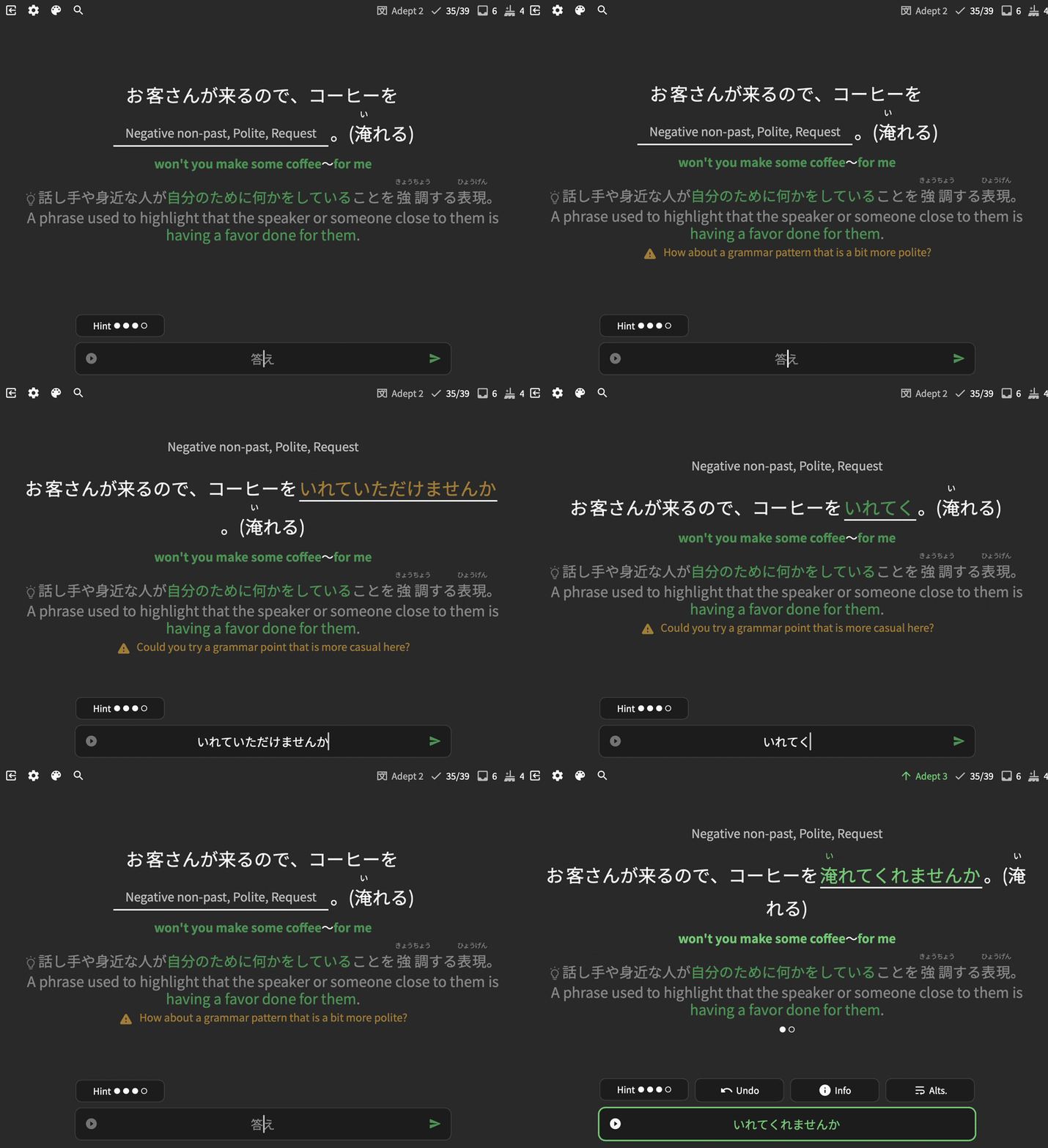
hints-ezgif.com-video-to-gif-converter-2

(I know I should have looked at the tense hints above though, lol.)

4 Likes

ニュアンスが違うので、他の答えを(Negative non-past, Polite, Request given on Tuesdays, not Fridays, by customer service representatives who are 愛想 but not overly abundantly so)。

How about a grammar pattern that’s a bit more Tuesday?

6 Likes

I’m confused by the hint for 普段. “The typical state of general things, or the condition immediately before or after a general depiction.”

What is “a general depiction”? Even as a native English speaker this doesn’t mean anything to me.

1 Like