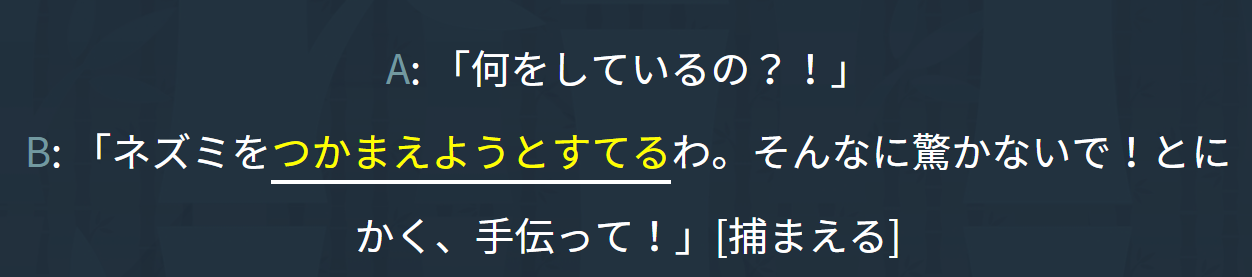
Verb[volitional]とする - ~ようとする・~おうとする - Grammar Discussion

English translation:
try to・attempt to・to be about to

Structure:
Verb[ よう ] + とする

Explanation:
[An action/attempt that requires effort, targets direct goals ・ Past tense suggests failure or lack of knowledge about result]

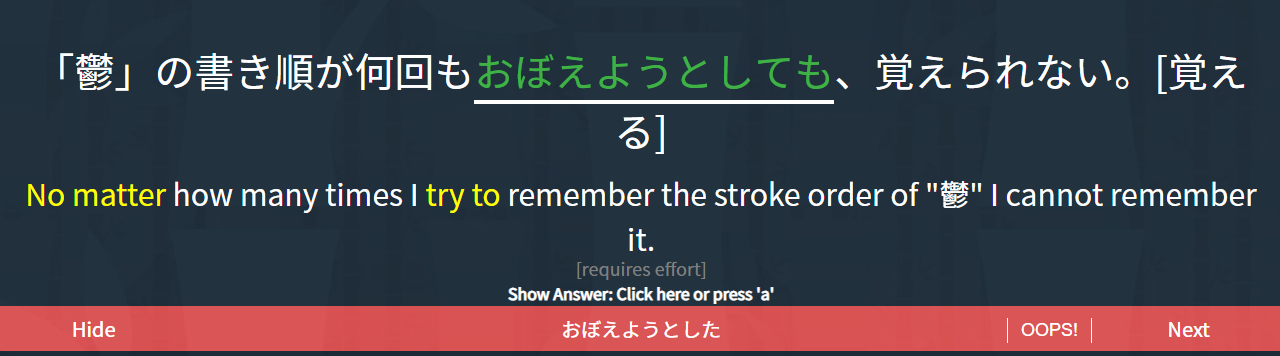
:warning: Verb[よう]としても(even if someone attempts to) can be contracted to Verb[よう] + たって/ったって。

View on Bunpro

I don’t think the alternate answers are valid.

1 Like

Fixed :laughing:

Sorry for that :bowing_man:

1 Like

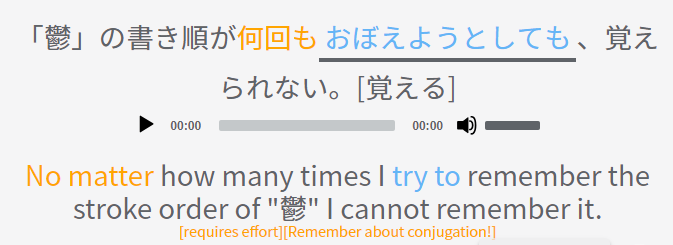
It was really not obvious from the translation that this needed to be in ても form. Now that I know the answer, the Japanese makes sense. But it’s hard to get this Japanese just from the English.

2 Likes

I bunpro392

Thanks for informing us about the issue!

I fixed it so that there should be no confusion. What do you think? :+1:

The “remember about conjugation” hint? Can’t say it would have helped. But I can’t think of a better wording for the English translation that would tell you to use ても form.

Also 何回も in color :wink:

1 Like

Just wanted to say that I really like the note next to the caution icon:

:warning: Verb[よう]としても(even if someone attempts to) can be contracted to Verb[よう] + たって/ったって。

…as it explains how its composed in terms of other grammar (albeit briefly), as I had wrote about a while back in a feature request.

I’m hoping this means I can expect more in the future ? :slight_smile:

2 Likes

I’m not sure if it’s just me, but I find the title of ~ようとする is a bit confusing at times.

Wouldn’t naming it “Verb[ volitional ] + とする” be much more fitting instead?

4 Likes

@Pep95 Sounds much more fitting! I have updated the title of the grammar point to match your suggestion. Cheers!

2 Likes

What’s the real difference between this point and ようにする (n4, lesson 7)?

2 Likes

The general answer from Stackexchange and HiNative seems to be that ようにする follows the second definition on Bunpro “to make sure that”, whereas ようとする is something you’re going to try to do. Perhaps it’d help to think about the N5 point にする to remember the difference.

1 Like

As I understand it, ようにする is usually attached to habits or larger end goals that you are trying to achieve. ようとする is attached to some effort that you are struggling to do.

ジムに行くようにする。I’m trying to go to the gym. (I’m trying to make it a regular habit, but I just started.)
ジムに行こうとする。I’m trying to go to the gym. (…right now, as we speak, but the wind and rain and traffic is making it impossible!)

1 Like

I don’t understand this test sentence:

ひよこは親のように飛ぼうとしても、できなかった。
Even though the chick attempted to fly like its parents, it couldn’t.

Neither Bunpro’s item, nor any of the linked resources explain when Verb[Volitional]としても would be used instead of Verb[Volitional]とする and what the difference is.

A warning note just briefly mentions it as (even if someone attempts to). This sounds like it would be used about hypothetical situations that haven’t happened yet.

In this sentence the situation already happened, the chick already tried to fly like parents and failed.

It sounds to me like 飛ぼうとしたが would be correct for a situation that already happened, but it is marked incorrect.

So, I’m playing through Pokemon Sapphire and am immediately tripped up on a sentence here: 調査しようと草むら入ったら突然ポケモンに襲われてとにかくたすかったよ。ありがとう。

This is in the scene where you save the prof from poochyena - he goes on to say, as I understand “I was about to do some research when suddenly a pokemon jumped out of the tall grass and attacked…”

I’m led to believe that he is using this grammar point in this sentence, but what confounds me is the fact that every grammar resource I look at indicates that this phrase is always followed by する。So, my question is, does this sentence actually use this grammar point and if so, why the omission here when I seem to be struggling to find other examples of the omission being allowed?

I cannot find a clear cut source for this, but I think you can interpret 「調査しようと、action」 as “in order to investigate, I’ve done action”. Volitional communicates intention and と is a quotation.

Maybe 「調査しようと思って草むらに入ったら」(〜ようと思う・〜おうと思う (JLPT N4) | Bunpro) is a way to unpack it, where と思う is shortened to と as it happens to it sometimes.

Another similar construction could be (~ようとしたら、result) (Verb[volitional] + としたが (JLPT N3) | Bunpro), but in this case instead of する there’s a more specific action 入る.

Hopefully someone can source this to a grammar book.